
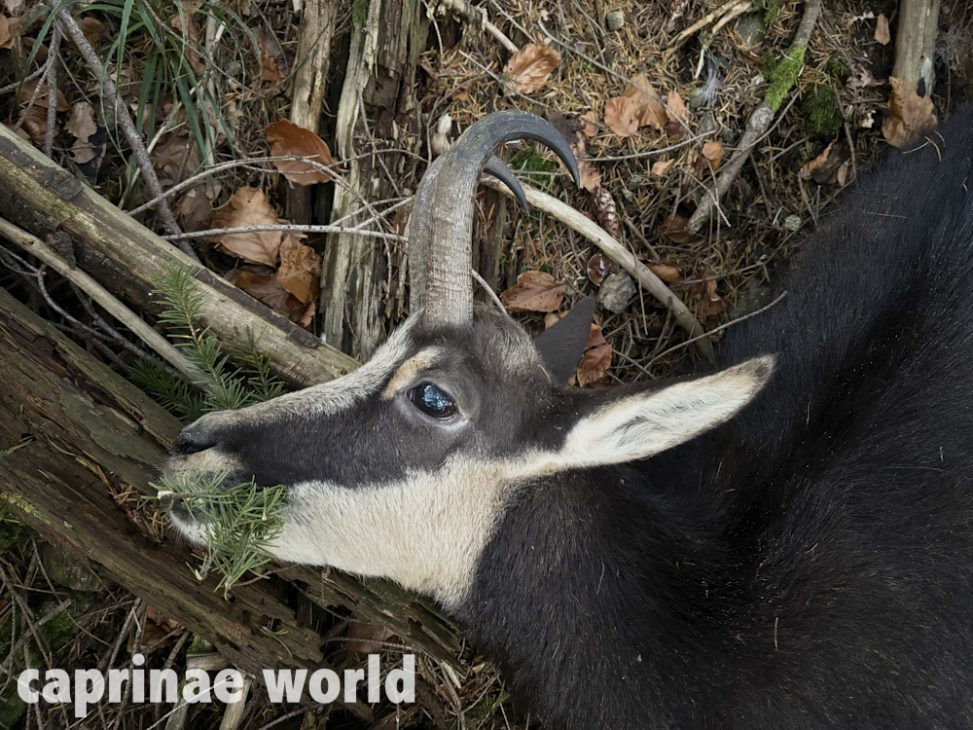
Part of hunting is also thinking about how it can be ethical and sustainable. This also applies to chamois hunting. Here are some key points summarised – which may surprise you when compared to practices worldwide.
- Respect the game. Avoid unnecessary disturbance. Avoid causing the animal suffering. Respect also the dead animal you have killed. [4]
- Respect the rules. Know the hunting laws!
- Respect the customs (in Alpine countries, for example, the „last bite“ (German: letzter Bissen) is given as a sign of respect: a small bouquet of certain plants that grow above the tree line, such as bilberry, alpine rose, or dwarf willow. It is placed in the mouth of the killed chamois.) But also be critical: separate tradition from ostentation. [4]
- Respect your colleagues – no hunting envy! (German: Jagdneid) [4]
- Respect others. Explain calmly and thoughtfully if hunting is not understood: “Loving and killing game may seem contradictory. But life has many contradictions and is still beautiful.” [4]
- Train your fitness. Getting out of breath can lead to uncontrolled shots.
- Practice mountaineering techniques (for example, walking with microspikes). Inexperienced people endanger themselves and disturb the wildlife.
- Control your temper. No greed to shoot! (German: Schussgier) [4]
- No „car stalking“ – limit vehicle use to the bare minimum! [4] (Note 1: The greater your effort to get the prey, the more vivid the memory of the experience. Note 2: Once the road is there, it will be used. Note 3: In countries where chamois only exist in remnant populations and low densities, car stalking is a standard practice. The chamois move between valleys. These are driven through by the hunting guides.)
- Be able to identify sex and age classes of chamois. [4]
- Internalise the generally accepted harvesting concept: Hunting must be sustainable and thus maintain a state of equilibrium. [4] This is achieved by: mainly reducing young animals, especially yearlings (up to 50 percent of the total cull is possible). Fawns can also be shot. Protect mature males (without them, the proportion of younger animals killed by cold and hunger increases). Old males (older than 13 years) can be shot. (It should be noted, however, that this class is naturally very small and often no longer exists in poorly managed areas.). Furthermore: The number of females shot should correspond to that of males. An unnatural shift in the sex ratio – too many females – has negative consequences (prolonged rut → delayed birth → increased fawn mortality [3]).
- Know your weapon. [4]
- Put yourself in a position to make a lethal hit with the first shot. Avoid long-range shots [4]. Keep in mind that especially on hunts abroad, there is a lot of pressure to „dare something“. It is also in the guide’s interest to get the client as quickly as possible to success. Don’t let yourself be pressured!
- Don’t shoot if your prey could fall down on a steep slope or cliff. [4]
- Whoever kills an animal also retrieves it, guts it, and carries it down the valley. [4] Weigh the options! On hunts abroad, it is customary for an assistant to take care of the game handling.
- Retrieve the prey properly (no dragging over long distances; no uncontrolled sliding). [4]
- The annual harvest must not exceed the annual increase if the population is to remain stable (maximum sustainable yield) [3]. Today, chamois management primarily means securing their distribution area. [2] This still doesn’t seem to be an issue on hunts in Turkey, for example. Confront your hunting guide with this issue; ask him what needs to be done so that your children can continue hunting here or so that the hunting guide’s children can take over his business.
- Collect data on harvested Chamois and share the data so that the right management measures can be implemented to protect the animals. This is especially important where chamois are threatened. Relevant data includes, for example, body measurements, weight, descriptions of the coat (photos), descriptions of the hunting area, and information on the size of observed chamois herds. The Council for Game and Wildlife Conservation (CIC) states that it is currently working on a “Caprinae Conservation Hunting Report” for this purpose. [1]
- Form an opinion on topics that are still controversially discussed, for example: Should you hunt at a manmade salt lick – yes or no? Is using a mobile phone while hunting chamois unsportsmanlike?, etc.
- Know: Community-based trophy hunting can curb poaching. Local poachers stop hunting when they benefit from the hunting fees paid by visiting hunters. [1]
Sources
[1] Damm, Gerhard R. and Franco, Nicolás, 2014: The CIC Caprinae Atlas of the World – CIC International Council for Game and Wildlife Conservation, Budakeszi, Hungary in cooperation with Rowland Ward Publications RSA (Pty) Ltd., Johannesburg, South Africa
[2] Knaus, W. Und Schröder, W., 1975: Das Gamswild: Naturgeschichte, Verhalten, Ökologie, Hege u. Jagd, Krankheiten. Verlag Paul Parey, Hamburg und Berlin
[3] Miller, C. Und Corlatti, L., 2009: Das Gamsbuch – Für Einsteiger und Profis. Neudamm-Neudamm, Melsungen
[4] Schnidrig-Petrig, R. and Salm, U. P., 2009: Die Gemse – Biologie und Jagd. Salm Verlag, Bern
Schreibe einen Kommentar